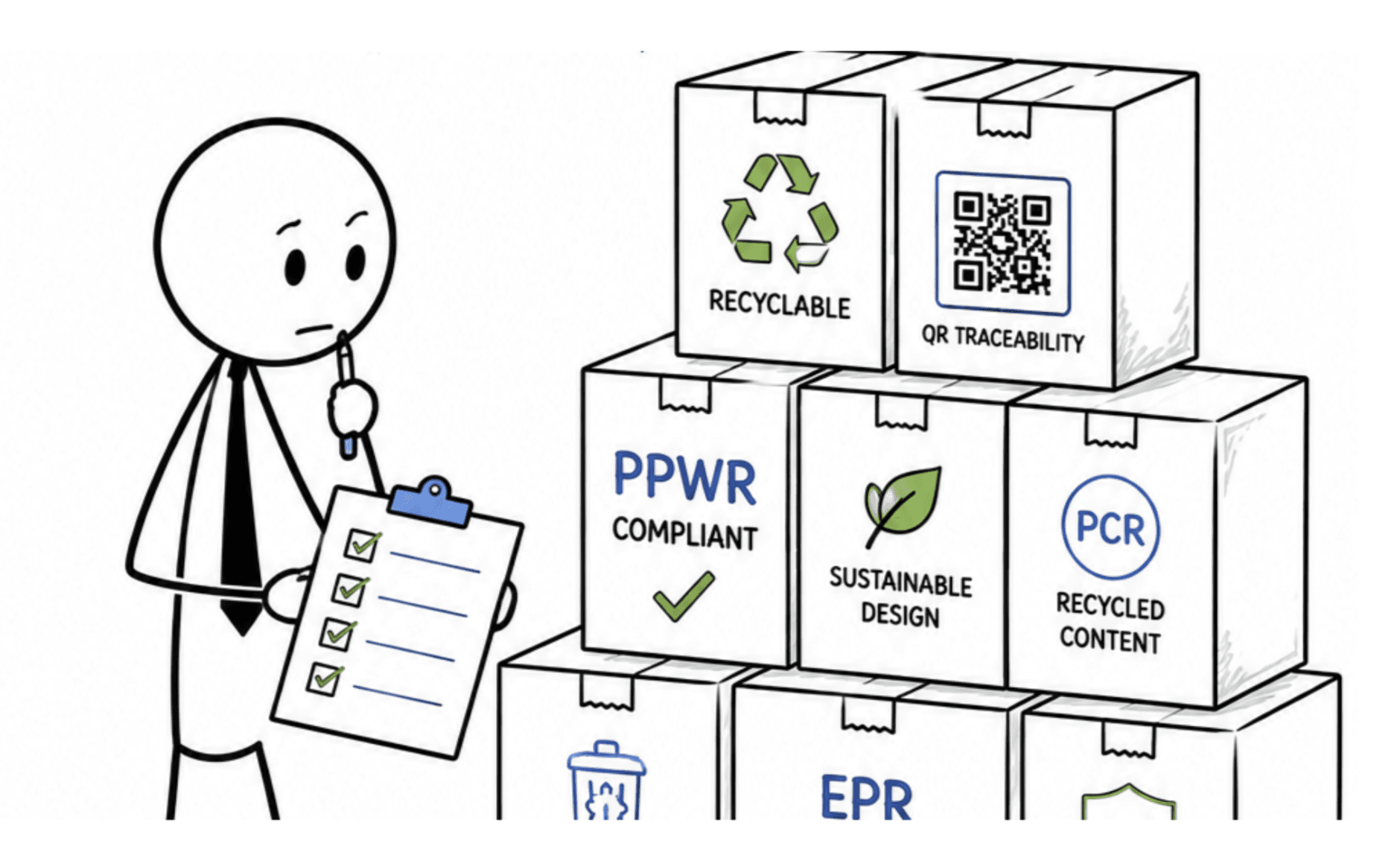
Explore the direct legal and financial liabilities of companies under the circular economy packaging rules of the EU imposed through PPWR.
In this short article, we will introduce you to the general provisions set out in the new Packaging and Packaging Waste Regulation (PPWR). It marks the beginning of a large-scale legislative reform of the market in the European Union, the main goal of which is the transformation of supply chains towards the so-called circular economy (reuse, repurposing or recycling of products - in this case packaging). With the implementation deadline of 12 August 2026 approaching, companies are faced with the urgent need to implement real changes in their documentation and the control process of the packaging supply chain. This includes not just a cosmetic change to the labels, but a comprehensive preparation for the introduction of mandatory recycling markings, new harmonised ecodesign criteria and a plan for the implementation of the schedule for increasing the % of recycled material in the packaging produced and used. This regulation is comprehensive in nature and affects absolutely all types of packaging placed on the market within the Union – from primary consumer packaging and transport cartons and pallets, to disposable utensils, regardless of whether they are sold empty or accompanying a finished product.
In real practice, the most critical point on which the success of any PPWR compliance strategy depends is the precise definition of the role of the economic operator in each individual chain. It is from this specific classification that the scale of mandatory registration in national systems, the reporting model and the direct obligation to cover the costs of Extended Producer Responsibility schemes (EPR fees) arise. Companies must establish an automated and fully traceable link between the technical specification of materials, the exact mass of each component and the actual market implementation by Member State.
At the heart of the new administrative control lies the Declaration of Conformity, which can no longer be treated as a formal document, but follows a clear form (Annex 8 to Regulation 2025/40). It must be based on specific, traceable and laboratory-verifiable data on the exact chemical and material composition, proven functional minimization of excess voids and full compliance with European restrictions on heavy metals and hazardous substances. Registration in the official register of manufacturers and contracts with waste recovery organizations must be fully in order before the product is placed on the market, including in the case of “seasonal marketing campaigns with a short life cycle”. A constantly updated register for each individual packaging unit must be maintained to prevent discrepancies between the agreed and declared parameters and the volumes and specifications actually delivered to the market.