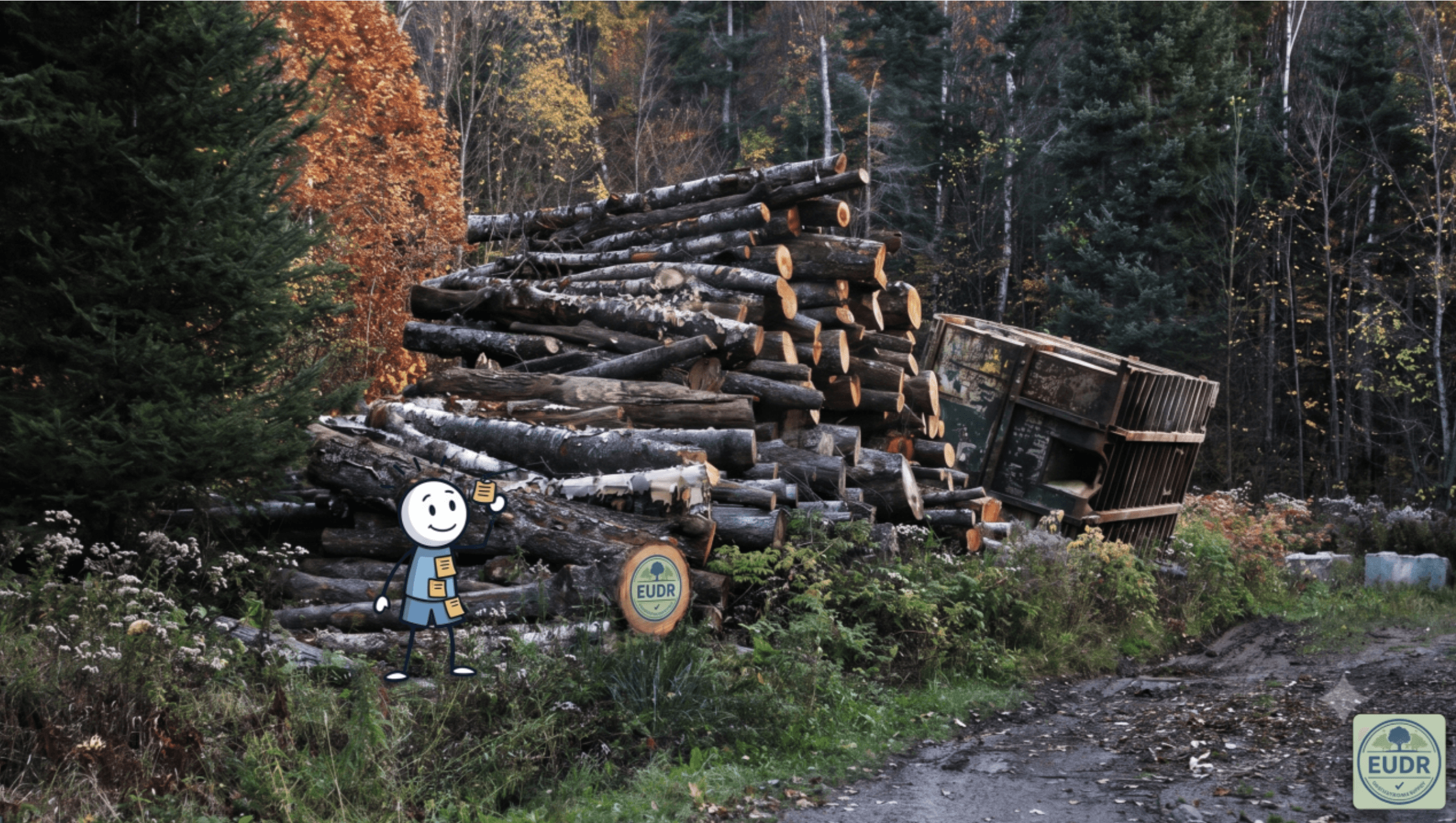
Navigating the rigorous wood traceabilty requirements under EUDR, from logging concessions to finished paper, packaging, and furniture.
Your office desk, kitchen cabinets, toilet paper, and shipping pallets — wood products are everywhere. The application date has moved to December 30, 2026 for large and medium operators, with June 30, 2027 for micro and small enterprises not already covered by the EU Timber Regulation (those already under EUTR keep the December 2026 date). For the industry that literally turns forests into products, EUDR isn't just regulation — it's an reckoning that's now arriving a year later than originally planned, with a sharper rulebook attached.
Wood's EUDR Complexity
Unlike agricultural commodities, wood products involve:
- Direct forest impact: Trees are the forest.
- Processing complexity: One log becomes dozens of products.
- Value chain length: From forest to furniture store.
- Species diversity: Different trees, different compliance requirements.
A draft Delegated Act amending Annex I, out for consultation from May 4 to June 1, 2026, proposes removing certain wood-based waste and packaging materials from scope entirely — worth watching closely if pallets or packaging are part of your business, though it isn't adopted yet, and the current Annex I still applies until it is. Furniture retailers and distributors selling a finished product that already carries a valid DDS from the manufacturer or importer are now treated as downstream operators and can skip their own risk assessment, though they still need to retain records of who they sold to. Timber-exporting countries are being individually assessed for country risk; a low-risk rating simplifies due diligence, while illegal-logging hotspots are likely to be rated standard or high risk, keeping the full burden in place. FSC and other certifications still don't equal compliance — the Commission's guidance reiterates that voluntary certification schemes are useful supporting evidence but don't, on their own, satisfy EUDR's requirement to verify land-use change after December 31, 2020. And legality due diligence is especially acute for wood: illegal logging is common in ways it simply isn't for most agricultural commodities, and practitioners consistently rank legality — land tenure, environmental law, labour rights, and free, prior and informed consent for indigenous communities — as the most unclear requirement across every commodity, wood included.
The Wood Products Universe
Solid wood covers furniture, construction lumber, and flooring. Engineered products include plywood, particleboard, and MDF. Paper products span everything from newspapers to packaging — worth watching closely given the proposed packaging exclusion — and specialty items include musical instruments, tool handles, and decorative pieces. Each category has different supply chain structures and compliance challenges.
Why Wood Traceability Is Genuinely Hard
One forest concession might have 50-plus tree species, and different logs routinely get processed together at the sawmill. One tree becomes multiple product types, and wood crosses borders multiple times during processing. Maintaining wood identity — chain of custody — through all of that is a massive challenge, and one mistake can invalidate the entire batch.
Wood's Unique EUDR Risks
Illegal timber operations are common in a way agriculture generally isn't, and forest concessions often affect indigenous communities directly. Forest management documentation varies wildly by country, and chain of custody has to survive multiple processing steps intact. The biggest myth is that some sources or types of wood are low-risk enough to skip the paperwork: the EUDR requires a full due diligence statement for all wood products regardless of perceived risk, and the proposed packaging exclusion is the one narrow exception on the horizon — one that isn't law yet.
What Companies Get Wrong
Companies assume plantation wood is automatically compliant, when expansion still matters; skip verifying forest concession legality and boundaries; ignore mixed-species processing challenges; and overlook paper product supply chains, which are often the most complex of all. A newer mistake is assuming the packaging exclusion already applies before the Delegated Act is formally adopted. And underneath it all, too many companies still believe existing certifications are enough — schemes like FSC are a good start, but they don't automatically cover every EUDR requirement, including land-use change after 2020.