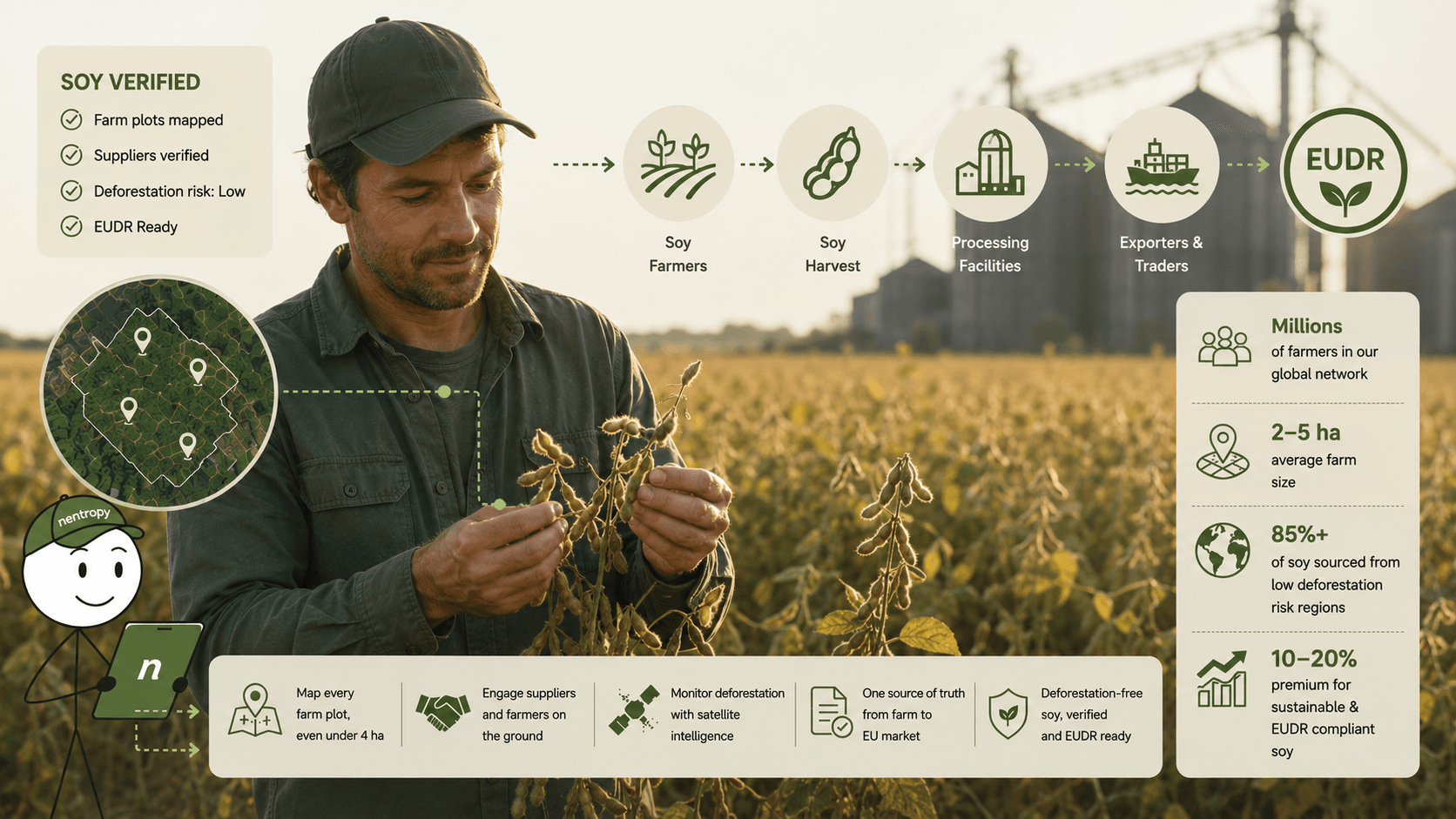
Explore the complexity of tracing soy derivatives from massive South American estates down to EU feed mills and consumer food products under the updated EUDR guidelines.
Soy isn't just tofu and soy sauce. It's in your chicken (via feed), your salmon (aquaculture feed), your chocolate (soy lecithin), and your margarine (soybean oil). The application date has moved to December 30, 2026 for large and medium operators, with June 30, 2027 for micro and small enterprises. For the crop driving Amazon and Cerrado deforestation, EUDR compliance is still make-or-break — you've just been handed another year to get it right.
The Soy Reality Check
75% of global soy becomes animal feed, and Brazil alone exports 83 million tons of it annually. The Cerrado savanna sees four times more soy-driven deforestation than the Amazon, and supply chains typically run through three or four intermediaries between farm and end user.
If the soy-derived ingredient in your feed or food product already carries a valid DDS from the crusher, exporter, or trader, you're now treated as a downstream operator and don't need your own risk assessment — genuinely useful given how deeply soy hides inside animal products, though you need airtight recordkeeping to prove your downstream status if a customs authority ever asks. Brazil's eventual country-risk rating, and whether the Cerrado ends up treated separately from the Amazon in practice, will materially change the risk-assessment burden for every crusher and trader sourcing there. It's worth being clear-eyed about who the smallholder simplifications actually help: the micro and small primary operator carve-outs, with their postal-address geolocation and one-off declarations, are aimed at genuinely small producers, and Brazilian soy farms running 1,000-plus or even 10,000-plus hectares remain standard operators under every version of the rule, full stop. Legality due diligence is arguably harder for soy than for any other commodity, simply because scale multiplies the number of underlying legal questions — land tenure across enormous properties, environmental permitting for continuous expansion, labour standards across large industrial operations. And it's crushers and major trading houses, as the operators who typically first place soy-derived products on the EU market, who will carry the annual due diligence reporting obligation once it takes effect after December 30, 2027.
Why Soy Is EUDR's Stealth Bomber
Most companies don't realize they're importing soy. It arrives via animal products — chicken, pork, salmon, eggs, all fed on soy — via food ingredients like lecithin, protein isolates, and oils, and via industrial uses like biodiesel, adhesives, and coatings. You might be a soy importer without knowing it, and now, without knowing whether you're upstream or downstream under EUDR either.
The Brazilian Soy Machine
At the farm level, massive properties of 1,000-plus hectares are common. Regional elevator and storage facilities blend multiple farms together, major trading companies like Cargill and ADM export the blended product, and end users often have no idea what the original farm sources even were.
Soy's Unique EUDR Challenges
Individual farms can run 10,000-plus hectares, under continuous pressure to clear new land. Massive storage facilities blend multiple sources together, and soy becomes dozens of different derivative products from there. The hardest part conceptually is what's sometimes called the "indirect" problem: the EUDR holds you responsible for soy even when it's buried inside something else, like the feed for livestock you import — a way of thinking about your supply chain that the downstream-operator category only partly solves.
What Soy Importers Get Wrong
Companies fail to realize they import soy at all, via animal products; assume certified soy equals EUDR compliance; focus on Amazon deforestation while ignoring the Cerrado; and don't trace back to the farm level through their trading companies. A newer failure mode is claiming downstream-operator status without the recordkeeping to back it up. Underneath all of it is a data problem: tracing soy lecithin, for example, is far more complicated than tracing a bag of soybeans, because the due diligence has to be product-specific.
The Numbers Game
EU soy imports run at €5-plus billion annually. Feed industry costs are up 20-30% for compliant sources, and food companies face reformulation costs wherever an ingredient isn't compliant.
What you don't know about soy can definitely hurt you. Your soy might come from a large-scale compliant farm, but it can be mixed with non-compliant product during transport or processing. nentropy traces every batch from the port to its final destination, correctly classifies whether your entity is upstream or downstream under the 2025/2026 amendments, and ensures your products are fully compliant and protected from fines.