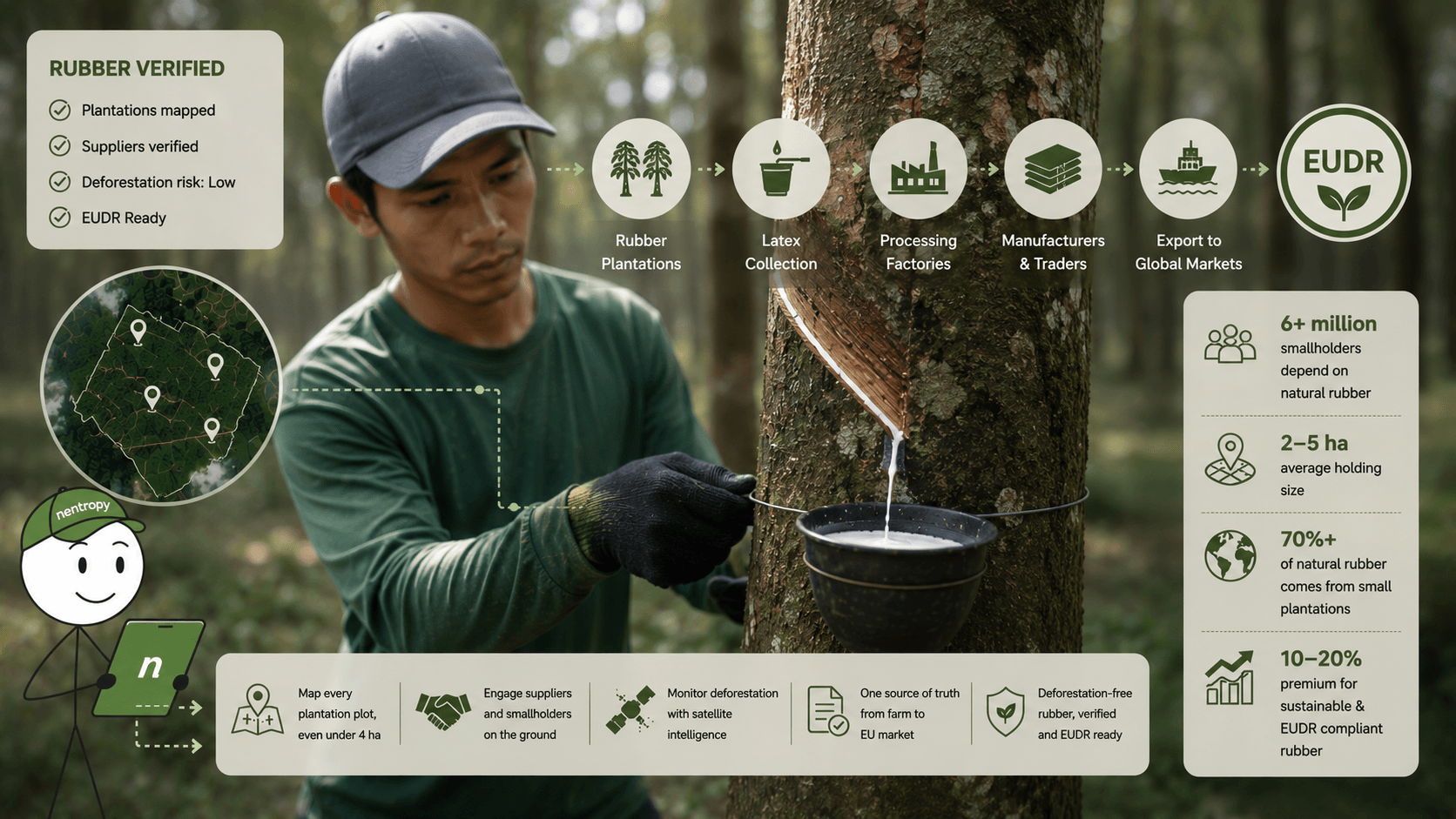
Uncover the hidden compliance risks in natural rubber supply chains, including the latest Delegated Act proposals regarding synthetic blends and retreading.
Natural rubber is in your car tires, medical gloves, shoe soles, and thousands of industrial products. The compliance deadline has shifted to December 30, 2026 for large and medium operators, with June 30, 2027 for micro and small enterprises. For an industry that's been quietly expanding into biodiversity hotspots, EUDR is still a wake-up call.
Rubber's Under-the-Radar Deforestation
While everyone watches palm oil and soy, rubber has been silently driving deforestation in Southeast Asian rainforests (Thailand, Indonesia, Malaysia), Amazon regions (Brazil), and African forests (Liberia, Cameroon).
There's real movement in how the rules treat rubber specifically. A draft Delegated Act on Annex I, out for public consultation from May 4 to June 1, 2026, proposes narrowing the scope of retreaded tyres so that only the new rubber tread added during retreading is covered, with the carcass and casing falling out of scope entirely — a genuine operational win for the retreading industry, though it isn't formally adopted yet. The same draft introduces an "ex" prefix logic across Annex I: a product is only covered if it's actually made using the regulated natural commodity, which means tyres manufactured entirely from synthetic rubber would not be EUDR products at all if the proposal goes through. Don't restructure your compliance program around it before it's law, though. Meanwhile, downstream manufacturers whose rubber compound already arrives with a valid DDS are treated as downstream operators and don't need their own risk assessment, though they still need to track and retain records of their onward sales. Where individual tappers or village collectors qualify as micro or small primary operators, a one-off simplified declaration and postal-address geolocation are now available — a meaningful simplification given how many of rubber's 6 million smallholders have never used GPS. Thailand, Indonesia, and Malaysia are each being assessed for country risk, which will determine whether tire and glove manufacturers owe full risk assessments on rubber sourced there. And as with every other commodity, legality due diligence — land tenure, environmental permitting, and free, prior and informed consent for affected communities, assessed plot by plot — remains the hardest requirement to actually operationalize.
The Rubber Reality
85% of natural rubber comes from 6 million smallholder farmers working average plots of 1-3 hectares. Tapping lifespans run 25-30 years, meaning long-term land use, and processing involves multiple steps between farm and finished product.
Why Rubber Traceability Is Uniquely Difficult
Smallholders tap trees daily and sell to local collectors, who sell to larger aggregators, who supply processing mills that turn raw latex into various rubber forms. From there, rubber compounds get blended with synthetic materials for manufacturing — and under the proposed "ex" prefix rule, the synthetic share may eventually be exempt while the natural rubber share stays fully in scope, meaning you'll need to document the split, not just the source. One tire might contain rubber from 100-plus different farms.
Rubber's Hidden Complexities
Old plantations might predate the 2020 cutoff, but expansion doesn't, so tree age alone tells you very little. Rubber is often grown intercropped with other plants, which complicates land-use verification, and mills and factories need their own compliance proof on top of what's happening at the farm. Mixed natural and synthetic products need segregation, which matters more than ever given the proposed Annex I changes, and collecting daily GPS data from millions of scattered farmers remains a genuine technological and logistical challenge — though the new postal-address option for qualifying micro and small operators takes some of the pressure off.
What Tire Companies Get Wrong
Tire companies routinely assume rubber plantations are automatically low-risk, when expansion is common; ignore collector and aggregator compliance; fail to differentiate between plantation and smallholder rubber; and overlook processing facility compliance entirely. A newer mistake is assuming the draft retreading and synthetic-rubber exclusions are already in force — they are not, until the Delegated Act is formally adopted. Underneath it all is a structural failure: satellite data alone isn't enough, and it needs to be combined with ground-level logistics data to actually prove compliance.
The Automotive Impact
The EU tire market runs at €40-plus billion annually, with compliance costs adding a 5-10% supply chain premium. The risk for non-compliant sources is complete supply disruption.
Rubber might be flexible, but EUDR compliance isn't. You need to verify every plot of land, but aggregators are mixing sources and smallholders have limited access to technology. N'entropy's smallholder rubber platform tracks daily collections, verifies plantation boundaries, and works directly with local collection networks across Southeast Asia — while keeping an eye on the Annex I delegated act so your scope determination updates automatically the moment it's adopted. We maintain identity through aggregator hubs and provide real-time satellite monitoring, giving you full confidence in your supply chain and protecting you from fines.