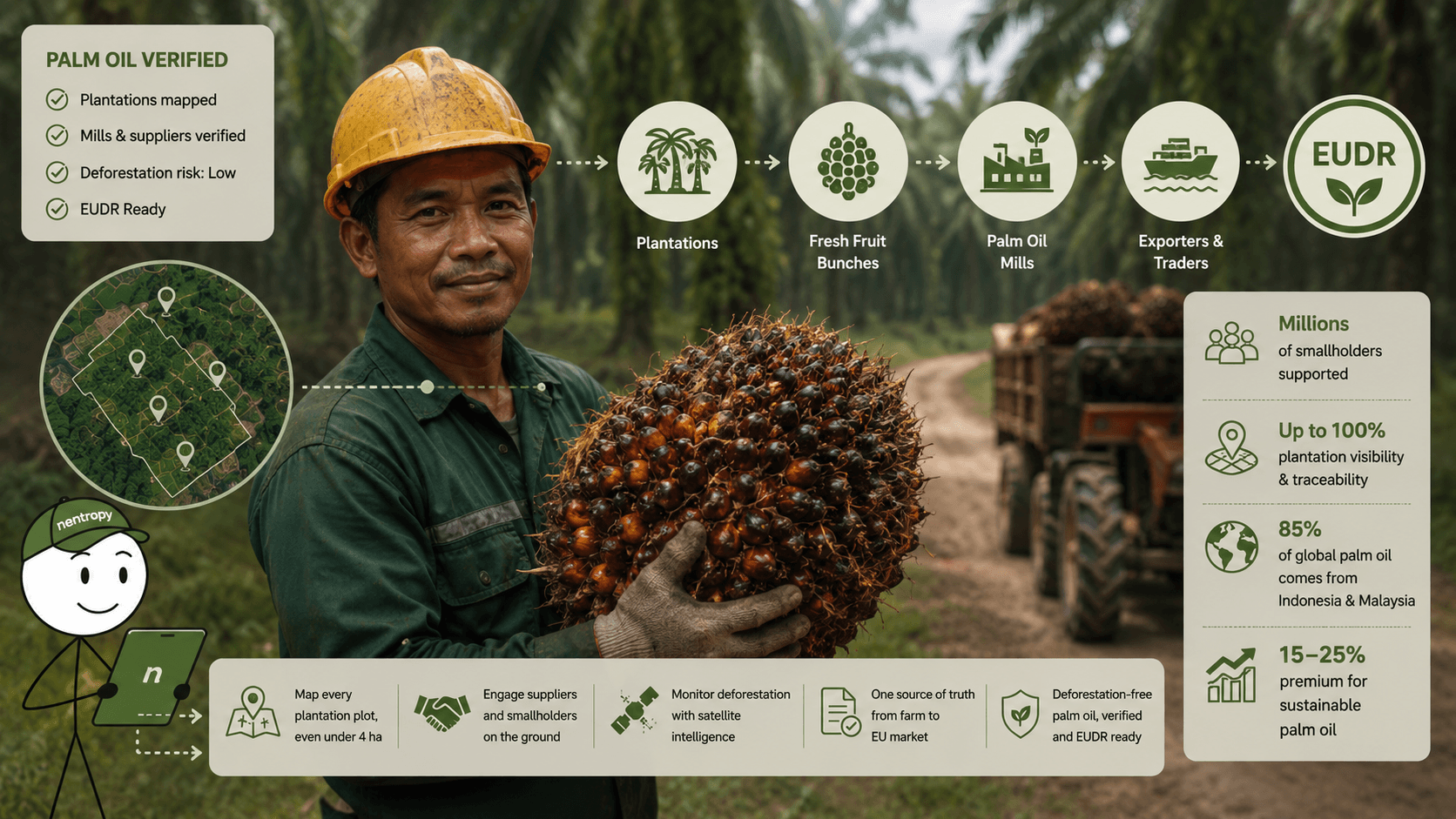
Navigating the palm oil traceability nightmare under EUDR. How to trace thousands of smallholders and ensure refinery compliance before December 2026.
Palm oil drives deforestation in Indonesia and Malaysia, the biodiversity hotspots everyone's trying to save. Roughly half of all packaged products contain palm oil, and 85% of it comes from those two countries, where plantations often replace pristine rainforest and supply chains involve thousands of smallholders and mills. Indonesia and Malaysia's eventual country-risk rating will be one of the most consequential single decisions in the entire EUDR rollout, given how much of global supply runs through them. Where a smallholder supplying a mill genuinely qualifies as a micro or small primary operator, they can now file a one-off simplified declaration with a postal address instead of precise coordinates — but that doesn't relieve the mill or refinery further down the chain of their own obligations. Cosmetics and food brands buying a palm-derived ingredient that already carries a valid DDS from the refiner or trader are treated as downstream operators and can skip their own risk assessment, though any evidence of risk — a supplier flag, an NGO report — reactivates due diligence immediately. RSPO certification still isn't a shortcut; it can support your evidence file, but it does not substitute for EUDR due diligence, a point the Commission has now made in writing across two guidance cycles. And legality due diligence remains the genuinely hard part: land tenure disputes are common in both Indonesia and Malaysia, and practitioners consistently rank legality, not deforestation mapping, as the most unclear compliance requirement.
The Palm Oil Traceability Nightmare
Your cosmetic cream might contain palm oil from 20-plus different plantations, five-plus processing mills, three-plus refineries, and multiple countries and ownership structures. Each step blends sources, making traceability nearly impossible with traditional methods.
What Makes Palm Different
Thousands of smallholders deliver to central mills that process mixed fruit, and crude palm oil from various mills gets mixed again during refining. From there, palm oil becomes 200-plus different ingredients, each with its own supply chain, and 40% of the raw material still comes from farmers working 2-hectare plots. Unlike other commodities, palm oil relies heavily on third-party certifiers and auditors — but under EUDR, you can't outsource your due diligence. The final responsibility is yours, or, if you're downstream, your upstream supplier's, and you need to be able to prove which one applies to you.
Palm Oil's Common Compliance Failures
Companies routinely focus only on plantations and ignore mill and refinery compliance, fail to map smallholder suppliers (the "last mile" problem), assume RSPO certification equals EUDR compliance, and overlook palm kernel oil, which runs a different supply chain than palm oil itself. The deeper failure is believing self-reporting is enough — without independent verification of your data, the claims you make about your supply chain won't hold up to scrutiny.
The Business Case for Clean Palm
Sustainable palm oil commands 10-15% premiums. Major brands are committing to deforestation-free sourcing. Early movers gain competitive advantage while late adopters face supply shortages when the December 2026 deadline finally lands.
Making Palm Oil Work
Stop assuming your palm oil is compliant. The real challenge is beyond the refinery, tracing every shipment back to thousands of smallholders and their individual plots. nentropy traces palm oil from plantation to product, even if you are working with smallholder cooperatives — monitoring plantation expansion in real time is easy, and mapping which entity in your chain owes a DDS under the upstream/downstream split is built in. We give you a single platform to manage complex supply chains, mitigate risk, and prove your product's compliance, turning palm oil from a liability into a brand asset.