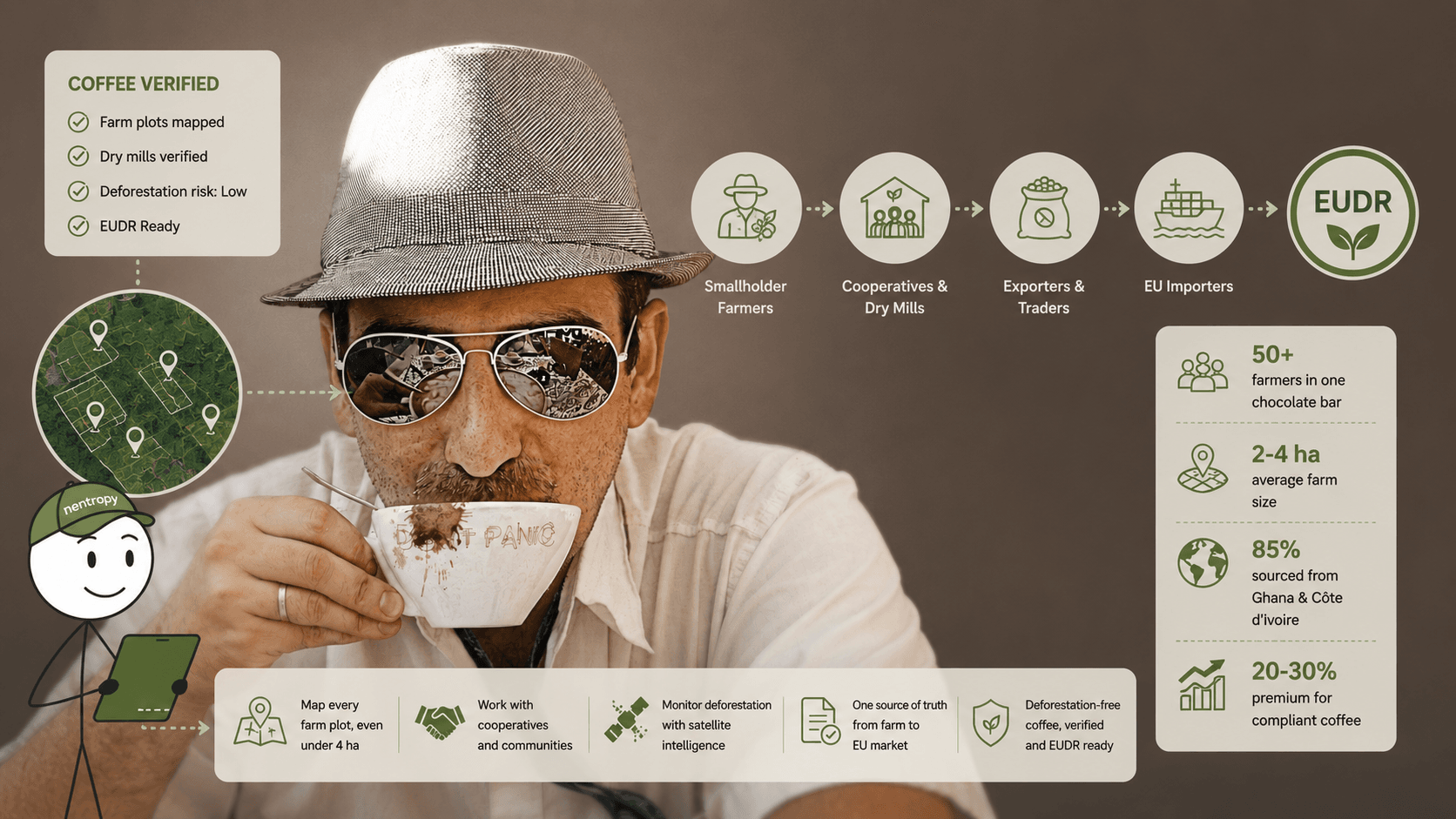
Every bean entering the EU needs deforestation-free proof by December 2026. Discover how your business can navigate coffee's unique supply chain hurdles.
Every bean entering the EU still needs deforestation-free proof — the deadline has simply moved to December 30, 2026 for large and medium operators, with micro and small enterprises given until June 30, 2027. Coffee comes from 70+ countries, involves 25 million farming families, and has supply chains more complex than your worst IT nightmare. The extra year is a gift. Treat it like one.
Coffee's EUDR Curveballs
Unlike other commodities, coffee is weird. Shade-grown coffee is cultivated under existing trees, which is good for forests but tricky for satellites trying to detect it. Sun-grown coffee often requires clearing land, which is bad for forests but at least obvious from orbit. Mountain terrain makes GPS mapping on steep slopes genuinely difficult, and intercropping — coffee mixed with other crops — complicates land-use proof further still. Specialty coffee adds its own wrinkle: smaller, more fragmented micro-lots are harder to verify than large industrial estates, precisely because they're the plots buyers care most about.
The exporter or first EU importer typically still carries the full due diligence statement (DDS) burden, but roasters and retailers buying beans that already carry a valid DDS are now treated as downstream operators — they don't need to run their own risk assessment, though they do need to retain the reference number and the identity of whoever they sold to. Where a farmer or cooperative genuinely qualifies as a micro or small primary operator, a one-off simplified declaration and postal-address geolocation are now available too, which matters a great deal for cooperative-linked smallholders across Latin America, East Africa, and Southeast Asia. Meanwhile, Brazil, Vietnam, Colombia, and Ethiopia are each being individually assessed for country risk, and a low-risk rating will mean simplified due diligence for beans sourced there — a real cost difference for roasters blending origins. What still trips most compliance teams up isn't the geolocation work everyone braced for; it's legality due diligence — land tenure, environmental permitting, labour standards, and free, prior and informed consent, assessed plot by plot against the law in force when the coffee was grown.
The Roaster's Dilemma
You're blending beans from 15 different countries, 200-plus individual farms, various altitudes and growing methods, and a mix of cooperatives, estates, and trading houses. One non-compliant farm contaminates your entire batch.
Where Coffee Companies Struggle
Treating all origins the same is a common mistake — Brazilian estates and Ethiopian smallholders don't face the same risks or need the same evidence. Companies ignore processing-location compliance, forgetting that wet mills need deforestation proof too, and assume certifications cover EUDR when they don't; it's a different standard entirely. Farms expand during good years, and seasonal variation gets overlooked as a result. And downstream-operator status gets confused with exemption — you still owe recordkeeping even when you're not filing your own DDS. Underneath all of it sits the biggest failure: relying solely on traders or exporters for aggregated data instead of verifying farm-level coordinates yourself.
The Specialty Coffee Problem
Single-origin, direct-trade, micro-lot coffee is, ironically, harder to verify than commodity coffee, because the supply chains are more fragmented and personal relationships often replace formal documentation. This is a due diligence nightmare — and the simplified declaration option only helps if your direct-trade partners actually qualify as micro or small primary operators under the EU's size thresholds.
What's At Stake
EU coffee imports run at €8.5 billion annually. Roasters forced to change suppliers can see a 15-25% margin impact. Consumer loyalty, increasingly sustainability-focused, is harder to put a number on but is worth just as much.
The Path Forward
Coffee trade's complexity is why we built N'entropy's origin tracking system to accommodate the industry. We map everything from Ethiopian highlands to Brazilian cerrados, working with cooperatives and estates alike, and we track exactly which of your entities is upstream or downstream so you're never duplicating — or missing — a DDS. Our platform provides real-time deforestation alerts that protect your sourcing relationships. Whether you're a roaster or a trader, N'entropy provides the verifiable data you need to prove your coffee is deforestation-free, making it a powerful selling point.